

By admin September 21, 2026
Connecticut’s 7.35% meals tax generally applies to taxable meals and certain beverages sold by eating establishments and caterers, including ready-to-eat prepared foods, hot foods, sandwiches, fountain drinks, coffee or tea, and qualifying takeout sales.
For a reliable Connecticut meals tax 7.35 setup, sellers should classify products first, then map each SKU or category to the legally correct POS tax group.
That answer sounds straightforward until a Hartford deli sells a sandwich, a whole loaf of bread, a fountain soda, a bottled beverage, a six-pack of pastries, and a take-home container of sliced turkey in the same transaction. Connecticut does not necessarily treat every one of those lines the same way.
The distinction also depends partly on who is selling the food. Connecticut Department of Revenue Services guidance applies a broad meals rule to restaurants, delicatessens, convenience stores, bakeries and other eating establishments, while a store that actually qualifies as a supermarket receives special rules.
DRS specifically excludes convenience stores and specialty stores such as bakeries and delicatessens from its supermarket definition.
For POS administrators, the practical lesson is that tax configuration must follow legal taxability rather than whatever default category came with the software. A “Food — 7.35%” button attached to an entire department can produce both overcollection and undercollection.
Connecticut Meals Tax Quick Reference
- 7.35%: Taxable meals and certain beverages, including qualifying restaurant and takeout meals, ready-to-consume prepared foods, sandwiches, fountain drinks, ready-to-consume coffee or tea, and taxable catering.
- 6.35%: Connecticut’s ordinary statewide sales-tax rate applies to taxable property that does not fall under another special rate. Some products excluded from the food exemption—such as carbonated beverages and candy—can fall here when they are not being taxed as meals under the meals rules.
- Exempt/other: Many qualifying food products for human consumption are exempt, including grocery-type food that remains within the statutory food exemption. Whole loaves, whole cakes and pies and other qualifying bulk-food sales can also be exempt in contexts identified by DRS.
- Key POS rule: Map Connecticut taxability at the item or legally defensible category level instead of applying one blanket food rate.
- Audit rule: Preserve the DRS publication, statute, ruling or professional analysis used to support each material tax mapping.
The most useful current DRS starting points are its Sales and Use Tax information page and Policy Statement 2002(2), Sales and Use Taxes on Meals.
Connecticut Meals Tax 7.35: Which Food and Drink Sales Get the Higher Rate?
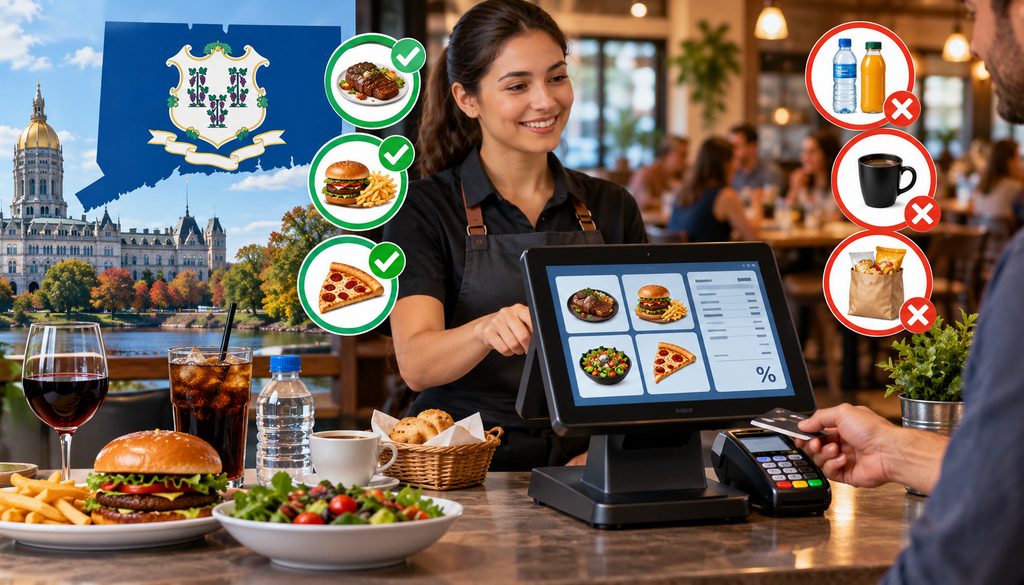
The Connecticut meals tax 7.35 rate applies to sales Connecticut classifies as meals and certain beverages. DRS currently lists a 7.35% rate for “sales of meals and certain beverages,” while its meals guidance defines meals broadly enough to cover ready-for-immediate-consumption foods sold by eating establishments, including takeout and delivered meals.
Connecticut’s statutory food exemption does not extend to “meals sold by an eating establishment or caterer.” The statutory definition describes a meal as food furnished, prepared or served in a form and portion ready for immediate consumption, including qualifying takeout food that is packaged or wrapped.
DRS Policy Statement 2002(2) expands that working framework. It says taxable meals include all food and beverages sold for human consumption at the seller’s location and foods normally sold in portions ready for immediate consumption at or near the seller’s location.
DRS specifically identifies prepared foods, prepackaged foods, hot foods, and foods heated on the premises for the purchaser.
The seller matters. DRS lists restaurants, coffee and donut shops, convenience stores, delicatessens, caterers, pizzerias, sandwich shops, snack bars, street vendors and similar businesses as sellers of meals. A supermarket receives a narrower set of special rules.
Why Connecticut has a 7.35% meals rate
Connecticut’s general sales-tax rate is 6.35%. Since October 1, 2019, taxable meals that had been subject to 6.35% generally carry an additional one percentage point, resulting in the 7.35% effective meals rate. Current DRS materials continue to list 7.35% for meals and certain beverages.
That extra percentage point does not make every edible product a 7.35% item. Connecticut continues to maintain a food-product exemption, specific non-food taxable categories, supermarket rules, meal rules, and other exemptions. The job at the register is therefore classification before calculation.
7.35% vs. 6.35% vs. exempt
| Item / transaction | Current treatment | Why | DRS authority |
| Taxable restaurant meal | 7.35% | Meal sold by eating establishment | DRS meals guidance |
| Hot prepared food sold as a meal | 7.35% | Immediate-consumption meal | PS 2002(2) |
| Prepared sandwich from eating establishment | 7.35% | Specifically listed taxable meal | PS 2002(2) |
| Fountain drink sold as a meal/beverage | 7.35% | Specifically listed taxable meal/beverage | PS 2002(2) |
| Ready-to-consume hot/iced coffee or tea | 7.35% when treated as a meal sale | Specifically listed | PS 2002(2) |
| Whole loaf of bread sold as qualifying bulk food by an eating establishment | Generally exempt | DRS identifies whole loaves as bulk food rather than meals | PS 2002(2) |
| Whole cake or pie sold as qualifying bulk food | Generally exempt | Bulk-food treatment | PS 2002(2) |
| Carbonated beverage outside meals treatment | 6.35% generally | Carbonated beverages are excluded from food exemption | DRS exemption guidance/statute |
| Qualifying grocery food product | Generally exempt | Food-products exemption | Conn. Gen. Stat. §12-412(13) |
| Taxable catering meal | 7.35% | Catering meals are taxable meals | PS 2002(2) |
A common misunderstanding is that everything that is not taxed at 7.35% automatically moves to 6.35%. That is false. Many Connecticut grocery-type food products are exempt rather than taxed at the general rate.
CT Prepared Food Tax: What Counts as a Meal or Prepared Food?
The CT prepared food tax question is best approached by asking whether the transaction meets Connecticut’s definition of a meal rather than applying a generic national “prepared food” test.
DRS says meals include food and beverages consumed at the seller’s location and foods normally sold in portions ready for immediate consumption. Prepared foods, prepackaged foods, hot foods, and food heated on the premises for the purchaser are specifically included in its current meals policy.
That means several facts can matter:
- how the food is prepared;
- whether it is ready to eat;
- portion size;
- whether it is sold for immediate consumption;
- whether the seller is an eating establishment, caterer, or qualifying supermarket;
- whether it falls within a DRS bulk-food rule; and
- whether a separate statutory exemption applies.
Heating matters, but “heated = taxable” is too crude
Seller-heated food is specifically within DRS’s description of taxable meals. A deli that grills a sandwich or a convenience store that sells hot roller-grill food therefore has a strong 7.35% meals-tax indicator.
But heating is not the only trigger. A cold prepared sandwich is also specifically identified as a taxable meal. Coffee, fountain drinks, pastries in smaller quantities, salad-bar food and many ready-to-eat cold products can be taxable without being heated.
Immediate consumption is a major concept
A taxable meal can be one item rather than an entrée-plus-side combination. DRS also says takeout and delivered meals remain meals. Packaging a sandwich in paper or putting a ready-to-eat salad in a takeout container does not by itself convert the transaction to exempt grocery food.
This is one reason the Connecticut meals tax 7.35 boundary should be attached to product characteristics and seller context rather than dining-room usage alone.
Expert Quote Placeholder — Connecticut CPA / Sales-Tax Advisor:
“[Insert verified commentary explaining why ready-to-eat classification is more reliable than trying to distinguish taxable food solely by whether the customer eats on-site.]”
Taxable Food Items Connecticut: Hot Food, Fountain Drinks, Bakery Items, and Catering
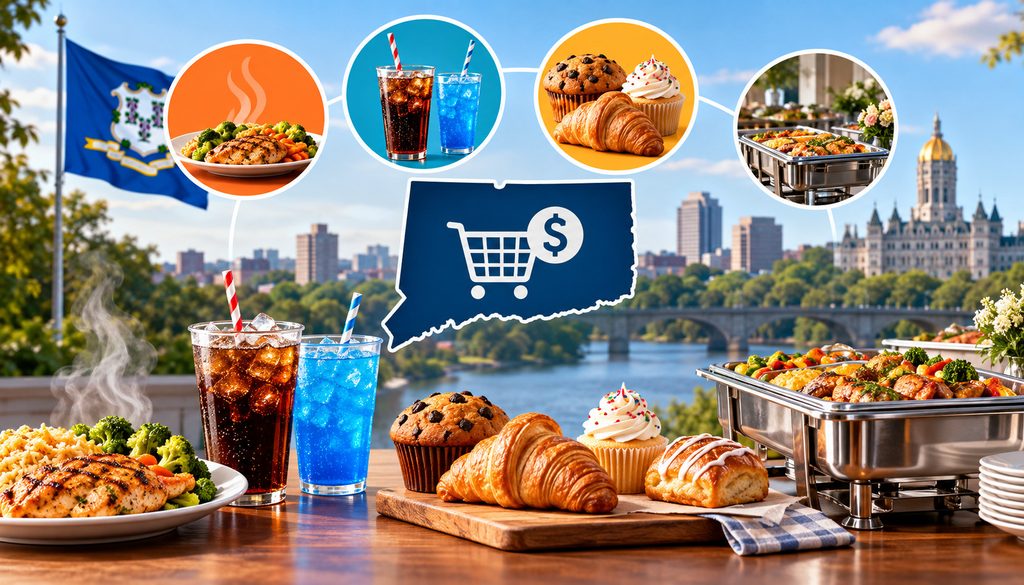
Operators searching for taxable food items Connecticut need more than a short “prepared food is taxable” rule. DRS provides concrete examples that can be translated directly into POS mapping.
Among foods identified as taxable meals in PS 2002(2) are:
- ready-to-consume hot or iced coffee and tea;
- sandwiches and grinders;
- fountain drinks, shakes and syrup-flavored crushed-ice drinks;
- salad-bar products;
- salads sold in containers under eight ounces;
- donuts, muffins, rolls, bagels and pastries when five or fewer are sold;
- qualifying small quantities of loose cookies;
- pie or cake by the slice;
- pizza, whole or by the slice;
- cooked chicken, including whole cooked chickens;
- ribs, including whole racks; and
- qualifying family-pack meals.
DRS also identifies certain bottled or canned fruit juices and drinks, milk and non-carbonated mineral or spring water in containers of 16 fluid ounces or less as taxable meals when sold in the relevant eating-establishment context, unless sold in qualifying prepackaged multi-unit packs.
Fountain drinks versus bottled drinks
A fountain beverage is expressly listed as a taxable meal. For an eating establishment or similar meals seller, this is a straightforward Connecticut meals tax 7.35 mapping candidate.
Bottled products need more care because Connecticut distinguishes between food products, beverages excluded from the food exemption, meal sales and supermarket transactions.
Carbonated beverages are excluded from Connecticut’s food-product exemption. If a bottled carbonated beverage is sold outside the meals classification, it is generally a regular taxable tangible-personal-property sale rather than exempt grocery food.
DRS separately identifies certain small bottled noncarbonated beverages as taxable meals in the eating-establishment context.
The practical POS rule is not “bottle = 6.35” or “bottle = 7.35.” Identify the product, seller type, container/packaging facts when relevant, and the DRS rule supporting the treatment.
Coffee and tea
Ready-to-consume hot or iced coffee or tea is specifically listed by DRS as a taxable meal. Supermarkets are also expressly required to tax coffee or tea prepared in the supermarket for takeout under the special supermarket rules.
A package of coffee beans or box of tea bags sold as grocery food is an entirely different product. The POS should not inherit the same tax code merely because both products are in a department called “Coffee.”
Bakery items
Bakery classification shows why SKU-level mapping matters.
DRS says five or fewer donuts, muffins, rolls, bagels or pastries are taxable meals in the eating-establishment context. It also says slices of cake or pie are taxable meals. By contrast, whole loaves of bread and whole cakes or pies qualify as bulk food and are generally not taxable meals.
A bakery that treats every baked item as one taxable department could therefore overcollect. A bakery that treats everything as exempt grocery food could undercollect.
How Delis, Bakeries, and Convenience Stores Decide Item by Item
A grocery-adjacent store can sell exempt food, general-rate taxable products and 7.35% meals in the same checkout. That is why the CT prepared food tax cannot be solved by assigning one rate to the entire deli, bakery or convenience-store department.
The Hartford deli problem
A delicatessen is specifically identified by DRS as an establishment that sells taxable meals. Prepared sandwiches therefore fall squarely into the meals analysis. DRS also lists ready-to-eat salads and other immediate-consumption items depending on quantity.
By contrast, a large take-home quantity that qualifies as bulk food may not be a taxable meal. Sliced deli meat sold as ordinary grocery food should not be automatically treated like a prepared sandwich merely because it comes from the same deli counter.
Bakery cafés need at least two logical categories
Consider a Hartford bakery café selling:
- one croissant;
- six pastries;
- a slice of cake;
- a whole cake;
- a hot coffee;
- a whole loaf;
- a breakfast sandwich.
Those are not safely handled with one “Bakery” rate.
The connecticut meals tax 7.35 logic can apply to the ready-to-eat pastry, cake slice, coffee and sandwich, while DRS bulk-food rules can lead to different treatment for the whole cake and whole loaf. Quantity-sensitive products deserve deliberate programming.
Convenience stores are not supermarkets under the DRS definition
This distinction is especially important.
DRS expressly excludes a store commonly known as a convenience store from its supermarket definition. A specialty bakery or delicatessen also does not qualify merely because it sells grocery-like products.
A convenience store may therefore have:
- hot roller-grill food mapped as a taxable meal;
- ready-to-eat sandwiches mapped as meals;
- fountain beverages mapped as meals;
- ordinary exempt grocery food;
- candy mapped to the ordinary taxable category;
- carbonated bottled beverages requiring their applicable taxable treatment; and
- other merchandise mapped under ordinary sales-tax rules.
True supermarkets have special rules
A qualifying supermarket is not generally treated as a seller of meals. DRS’s current policy identifies three principal supermarket situations that are taxable meal sales:
- supermarket catering;
- sandwiches, grinders, coffee or tea prepared in the supermarket for takeout; and
- meals purchased in an area of the supermarket designated for eating, such as a snack bar or food court.
That can produce results that look surprising when compared with a convenience store or specialty deli.
| Seller | Item | Likely treatment under cited rule | Mapping note |
| Restaurant | Hot entrée | 7.35% | Standard meals group |
| Deli | Prepared sandwich | 7.35% | Meal SKU |
| Deli | Qualifying bulk grocery food | Exempt/other | Do not inherit sandwich rate |
| Bakery | Cake slice | 7.35% | Immediate-consumption meal |
| Bakery | Whole cake | Generally exempt bulk food | Separate SKU/category |
| Convenience store | Hot roller-grill item | 7.35% | Meal category |
| Convenience store | Fountain drink | 7.35% | Meal/beverage category |
| Supermarket | Prepared takeout sandwich | 7.35% | Special supermarket meal rule |
| Supermarket | Meal purchased in food-court area | 7.35% | Eating-area rule |
| Supermarket | Other qualifying grocery food | Generally exempt | Supermarket rule applies |
Meals Tax POS Setup: Creating the Right Tax Groups
A good meals tax POS setup starts with tax research, not with the POS settings screen.
At minimum, many Connecticut food sellers will need three conceptual buckets:
| POS tax group | Rate | Example use | POS purpose |
| CT Meals | 7.35% | Taxable prepared meal, fountain drink, qualifying coffee, restaurant takeout | Applies meals rate |
| CT General Taxable | 6.35% | Taxable goods outside special meals rate | Applies ordinary state rate |
| CT Exempt / Other | 0% or applicable treatment | Qualifying exempt food or other supported exemption | Prevents inappropriate tax |
Those names are operational labels, not legal terms. A POS installer may use different names, codes or tax objects.
The important point is that the Connecticut meals tax 7.35 tax group should contain only items for which the business has a defensible Connecticut meals classification.
Tax mapping is easier to maintain when POS reporting and transaction-management tools preserve enough detail to trace sales, refunds, tax amounts, and other checkout activity. Taxability should still be determined from Connecticut law and DRS guidance rather than from the POS system’s default product categories.
Item-level tax mapping
For each SKU or menu item, keep at least:
- item name;
- SKU or menu ID;
- seller/location;
- product category;
- DRS classification;
- applicable tax group;
- modifier behavior;
- online-ordering tax group;
- delivery-platform tax treatment;
- effective date;
- source used; and
- last review date.
This makes meals tax POS setup reproducible. A new menu manager should be able to determine why “Turkey Sandwich” is taxed differently from “1 lb. Sliced Turkey” without relying on oral history.
Modifiers can change the transaction
Modifiers should not be assumed to inherit tax harmlessly.
A “heat it” option, prepared drink addition, combo beverage, side item or bundled upgrade may need review if it changes the classification or taxable base. Connecticut expressly treats seller-heated foods and many ready-to-eat items as meals, so businesses offering optional preparation should test the actual configured transaction.
Do not create an automated rule such as “any modifier makes the base item taxable” unless the Connecticut rule actually supports that outcome.
How to test mixed baskets before going live
A mixed-basket test exposes bad mappings much faster than checking items individually.
Assume, purely for testing:
- prepared sandwich: $12.00 at 7.35%;
- qualifying exempt grocery item: $6.00;
- fountain drink: $3.00 at 7.35%;
- bottled taxable product mapped to 6.35% under the business’s documented classification: $2.50;
- qualifying exempt whole loaf: $5.00.
The illustrative receipt should calculate tax by line rather than tax the $28.50 basket as one uniform category.
| Test item | Price | Expected rate | Illustrative tax |
| Prepared sandwich | $12.00 | 7.35% | $0.882 |
| Exempt grocery item | $6.00 | 0% | $0 |
| Fountain drink | $3.00 | 7.35% | $0.2205 |
| General-tax bottled item | $2.50 | 6.35% | $0.15875 |
| Whole loaf qualifying as bulk food | $5.00 | 0% | $0 |
Actual receipt rounding depends on the POS and applicable Connecticut rounding requirements; this table demonstrates tax-group behavior, not a filing calculation.
Cashier overrides
Tax overrides should usually be restricted because an override can defeat carefully researched item-level mapping.
A practical control is to:
- allow only managers to override tax;
- require a reason code;
- retain an override log;
- review unusual overrides periodically; and
- fix the underlying SKU instead of repeatedly overriding it.
That is an internal control recommendation, not a claim that DRS mandates a specific manager-approval system.
Online ordering and kiosks
Online tax settings can drift away from the physical POS.
A restaurant might fix a sandwich from 6.35% to 7.35% on the in-store register while the website, kiosk and delivery marketplace continue using the old rate. That creates multiple versions of the same product tax rule.
The Connecticut meals tax 7.35 mapping should therefore be tested in every sales channel, not just the countertop terminal.
Delivery Platforms, Service Charges, and Gratuities
Third-party ordering creates two separate questions: Who is legally collecting/remitting the tax? and Does the underlying menu mapping still reflect Connecticut taxability?
Connecticut marketplace-facilitator guidance treats a qualifying facilitator as the retailer for sales it facilitates and requires the facilitator to collect and remit the applicable Connecticut tax under the marketplace rules. Marketplace sellers also have reporting obligations and must retain support for facilitated sales treated accordingly.
A restaurant should therefore identify each delivery relationship rather than assuming every app works the same way.
A restaurant should also keep a genuine service charge separate from a fee triggered specifically by the customer’s payment method. Connecticut has distinct rules governing credit-card surcharges, cash discounts, and payment-method pricing, so the POS should not use the same charge code for these legally different concepts.
Delivery fee treatment
Connecticut DRS ruled in 2018 that a food-delivery company reselling restaurant meals had to include its delivery fee in taxable gross receipts for the meals because Connecticut’s gross-receipts definition includes retailer shipping and delivery charges.
That ruling predates the 7.35% rate increase but remains useful on the tax-base question. Businesses should apply the current rate and determine who is the retailer/facilitator for the actual transaction.
Marketplace delivery reconciliation
The accounting chain should be reconstructed gross to net:
Customer order → taxable lines → tax → delivery/service charges → platform collection → platform fees → net merchant payout
If a customer paid $108 but the delivery platform deposited $78 after commissions, marketing charges and other deductions, the $78 bank deposit is not automatically the merchant’s gross taxable-sales figure.
Reconcile platform reporting separately from the processor or bank deposit.
During reconciliation, gross transactions, processor fees, refunds, chargebacks, and net settlements should remain separately traceable rather than treating the amount deposited in the bank as the original customer sale. This becomes especially useful when a delivery platform deducts commissions and other charges before sending its payout.
Mandatory service charges
Connecticut regulations generally include a mandatory service charge in gross receipts from meals unless the seller establishes both that the charge does not benefit the seller and that the entire charge is remitted to the service personnel who actually provided meal service. DRS states that using the charge to reduce payroll or other seller expenses is a benefit to the seller.
That means a POS should not map every line labeled “service charge” as a nontaxable tip.
Voluntary gratuities
A genuinely voluntary gratuity should be distinguished from a mandatory charge. The decisive facts include whether the customer determines the payment and whether the restaurant retains or reallocates it.
For POS purposes, use separate objects for:
- voluntary tip;
- mandatory restaurant service charge;
- catering service charge;
- delivery fee; and
- payment-method pricing adjustment.
| Charge type | Connecticut tax issue | What the POS team should verify |
| Meal price | 7.35% if taxable meal | Item classification |
| Delivery charge tied to taxable meal | Can be included in taxable gross receipts | Who is retailer and how charge is calculated |
| Mandatory service charge | Generally included unless regulatory exception is established | Destination/use of charge |
| Voluntary tip | Treat separately from mandatory charges | True voluntariness and accounting flow |
| Platform commission | Usually a settlement deduction, not reduction of customer gross sale merely because withheld | Reconciliation |
| Marketplace-collected tax | Facilitator may collect/remit under marketplace law | Contract, facilitator status, platform reports |
Hartford Restaurant Sales Tax: State Rate vs. Local Misconceptions
There is no separate City of Hartford restaurant sales-tax rate layered on top of Connecticut’s statewide 7.35% meals rate in the current DRS statewide rate schedule.
So the phrase Hartford restaurant sales tax should not be interpreted as “7.35% Connecticut tax plus a Hartford city restaurant tax.” The relevant meals rate discussed here is imposed under Connecticut law and administered by Connecticut DRS.
For consumers, this explains why the same qualifying restaurant meal generally carries the same Connecticut meals rate in Hartford, West Hartford, New Haven or another Connecticut municipality, assuming no special transaction-specific rule changes the outcome.
For businesses, location still matters operationally because each establishment may have a different menu, item master, ordering platform or POS instance. Tax rate jurisdiction may be statewide, but configuration errors can be store-specific.
This is another reason the Hartford restaurant sales tax discussion should focus on accurate Connecticut mapping rather than inventing a local tax.
Featured answer: Does Hartford have a separate restaurant sales-tax rate?
No separate Hartford restaurant sales-tax rate appears in Connecticut DRS’s current statewide meals-rate guidance. Qualifying meals and certain beverages are subject to Connecticut’s 7.35% rate.
Hartford restaurants should therefore configure the applicable Connecticut meals tax rather than adding a separate city restaurant tax unless a new local rule is independently identified and verified.
What a Connecticut DRS Restaurant Audit Looks For
A Connecticut DRS restaurant audit is fundamentally about whether the proper tax was reported and paid.
DRS’s published retail-audit policy defines an audit examination as an examination of returns to determine whether the proper tax was reported. It also expressly recognizes that DRS can use sampling, meaning one or more taxable periods may be selected as test periods and reporting errors can be extrapolated across the audit period.
That does not mean every restaurant audit uses the same months, percentages or sample design. Businesses should not rely on generic claims such as “DRS always samples three months.”
Records a restaurant should be ready to reconcile
| Record | What it shows | Why it matters |
| POS sales reports | Gross sales by item/category/tax group | Reveals tax mapping |
| Item master / menu export | Tax code attached to each SKU | Shows configuration |
| Filed OS-114 returns | Sales and tax reported to DRS | Filing baseline |
| Merchant processor reports | Gross card transactions, refunds, chargebacks | Independent sales evidence |
| Bank statements | Settlement deposits | Reconciliation support |
| Delivery-platform reports | Gross marketplace orders, tax, fees, refunds | Third-party channel |
| Purchase invoices | Product mix and business activity | Corroboration |
| Exemption documentation | Basis for exempt transactions | Supports exclusions |
| Service-charge reports | Mandatory/voluntary charge treatment | Tests taxable base |
| Tax override logs | Manual changes | Shows exception activity |
A processor statement does not tell DRS whether a turkey sandwich should have been 7.35%. It can, however, reveal that gross card activity materially exceeds sales reported through the tax return or POS.
For this reason, a Connecticut DRS restaurant audit can expose an apparently small POS configuration mistake if the error affects a high-volume SKU for multiple periods.
Audit lookback period
Connecticut’s ordinary limitation period for a sales-tax deficiency assessment is generally three years after the later of the applicable statutory date or filing of the return. The three-year limitation does not apply in cases such as fraud, intent to evade the sales-and-use-tax law or failure to file a return. Written extensions can also affect the period.
So “DRS can only go back three years” is too broad.
A filed return, unfiled return, fraudulent return and taxpayer-signed statute extension do not necessarily share the same limitation result.
Sampling
Connecticut DRS publicly defines sampling as examining one or more taxable periods as a test period and extrapolating errors over the audit examination period.
That makes consistency important. If one SKU was misclassified throughout a sample period, a business may have to establish exactly when the error began, when it ended and whether the same configuration applied throughout the broader period.
How an assessment can develop conceptually
The sequence is usually easier to understand than the math:
Taxability issue identified → affected sales measured → reported tax compared with correct tax → tax difference calculated → applicable statutory interest and penalties addressed
Connecticut law imposes interest and penalties in specified circumstances, but those amounts should be calculated from the current statute and the taxpayer’s actual facts rather than guessed in advance.
Data Placeholder: If the editor locates a current official Connecticut DRS statistic on sales-tax audit activity or restaurant/food-service taxable sales, insert it here with the reporting year and population clearly identified. Omit this box if no directly relevant official figure is available.
Fixing Historical Misclassification and Filing Amended Returns
A forward POS fix does not erase a historical Connecticut meals tax 7.35 error.
If a business discovers that prepared sandwiches were taxed at 6.35% rather than 7.35% for 18 months, it should first quantify the old periods separately from the new configuration.
A 12-step historical cleanup workflow
- Export the historical item catalog: Preserve the SKU, category and tax-code history if available.
- Identify incorrectly mapped items: Separate clear errors from products requiring professional review.
- Determine affected dates: Do not assume the current tax flag existed for the entire business history.
- Export sales by affected SKU.
- Calculate the tax that was actually collected.
- Calculate the tax treatment that should have applied.
- Compare the difference by filing period.
- Reconcile the result to file OS-114 returns.
- Review the issue with DRS guidance and, where material, a Connecticut tax professional.
- File amended returns for affected periods when required.
- Correct and test the POS prospectively.
- Document the change date, source and person approving the mapping.
DRS says that if a sales-and-use-tax return contains a mistake or omission, the taxpayer must correct it by filing an amended return. Current Form OS-114 filing is electronic through myconneCT.
The official DRS amendment/refund guidance is available through its Sales and Use Tax “Other Helpful Information” page.
Undercollection
A retailer is responsible for collecting Connecticut sales tax and is liable for paying the tax due even when it failed to collect the required amount from the customer. DRS says sellers must file and pay the full tax due.
This is why a wrong POS setting can create a merchant liability rather than merely an inconvenience.
If $10 was taxable at 7.35% but the register collected only 6.35%, changing tomorrow’s tax flag does not resolve yesterday’s one-percentage-point shortfall.
Overcollection
Collecting too much tax is also not revenue.
Connecticut’s refund policy says a retailer seeking a refund of tax collected from customers generally must demonstrate that the tax was collected and remitted and must refund or credit the affected customers as required by DRS procedures. An amended return claiming refund must generally be filed within the applicable three-year window.
The remediation can be more complicated when individual cash customers cannot readily be identified, so a business facing substantial overcollection should obtain tax advice rather than simply netting the excess against future sales.
Illustrative historical cleanup example
Assume a Hartford seller finds $75,000 of taxable meals that were incorrectly mapped to 6.35% rather than 7.35%.
Illustrative tax at 6.35%:
$75,000 × 0.0635 = $4,762.50
Correct tax at 7.35%:
$75,000 × 0.0735 = $5,512.50
Difference:
$750
The calculation demonstrates the one-percentage-point gap. It does not determine the merchant’s final liability because actual tax collected, inclusive/exclusive pricing, filing periods, refunds, interest, penalties and other facts must still be reviewed.
Common Connecticut Meals-Tax Mapping Mistakes
Several recurring assumptions can produce poor meals tax POS setup.
Misconception: “Everything sold in a restaurant is automatically 7.35%”
Not necessarily. DRS specifically recognizes bulk-food treatment in eating establishments, including whole loaves and whole cakes or pies. The actual transaction still matters.
Misconception: “Cold food is not a meal”
Incorrect. Sandwiches, cold ready-to-eat products, certain salads and other immediate-consumption products can be taxable meals.
Misconception: “All bottled and fountain drinks are treated identically”
Incorrect. Fountain drinks are expressly listed as taxable meals. Connecticut also distinguishes different bottled products and excludes carbonated beverages from the ordinary food exemption.
Misconception: “My POS company determines the tax”
A POS vendor supplies software. Connecticut statutes and DRS guidance determine taxability.
The vendor can program a rule correctly or incorrectly. The merchant should know which source supports the mapping.
Misconception: “The delivery app handles everything”
A qualifying marketplace facilitator may collect and remit tax for facilitated transactions, but the business still needs to understand the contract, reporting, menu tax data and reconciliation. Marketplace orders should not become a black box.
Misconception: “Hartford has another restaurant tax”
Current DRS rate guidance identifies the statewide 7.35% meals rate, not a separate Hartford meals add-on. That is the relevant Hartford restaurant sales tax distinction for this article.
Misconception: “Fixing the POS today solves prior periods”
No. Historical periods may need separate quantification and amended returns.
| Mistake | Tax/audit risk | Better approach |
| One tax rate for whole menu | Over- or undercollection | Map by supported category/SKU |
| Copying another state’s tax setup | Wrong Connecticut rules | Build from CT DRS authority |
| One deli tax code | Misses bulk/grocery distinctions | Separate prepared meals from other food |
| Treating all drinks identically | Wrong meals/general/exempt classification | Map beverage categories separately |
| Mapping mandatory service charge as “tip” | Wrong taxable base | Separate service charge from voluntary gratuity |
| In-store fix only | Website/app remains wrong | Synchronize and retest all channels |
| Trusting marketplace net payout as sales | Understated gross activity | Reconcile gross order to net payout |
| Unlimited tax overrides | Inconsistent receipts | Restrict and log overrides |
| No historical review | Past liability remains | Quantify affected periods |
Real-World Connecticut Examples
These examples are hypothetical and apply the cited DRS framework. Actual products and facts should still be verified before implementation.
Example 1 — Hartford deli
A customer buys a prepared cold turkey sandwich, a fountain drink and a larger take-home grocery quantity that qualifies under the relevant food/bulk rules.
The sandwich and fountain drink fall within DRS’s taxable-meal examples and should generally map to 7.35%. The grocery or qualifying bulk-food item should use its separate Connecticut treatment rather than inheriting the sandwich tax group.
This is a typical taxable food items Connecticut scenario where department-level tax mapping fails.
Example 2 — Bakery café
A customer buys a slice of cake, hot coffee and a whole loaf.
DRS identifies the cake slice and ready-to-consume coffee as taxable meals. A whole loaf is listed as a bulk-food example that is generally not a taxable meal.
The receipt should therefore be able to carry multiple tax treatments.
Example 3 — Convenience store
A customer buys a hot roller-grill item, fountain drink, packaged grocery food and bottled carbonated drink.
The hot prepared item and fountain beverage fit Connecticut’s meals framework. The grocery item and bottled beverage require their applicable separate food/general-sales-tax analysis. Because convenience stores do not receive the supermarket classification merely because they sell groceries, the POS should not import supermarket rules wholesale.
Example 4 — Caterer
A Connecticut caterer prepares trays of hot food, delivers them to an office, and imposes a mandatory service charge.
DRS says catering includes preparing and serving meals or preparing and delivering them, and that preparation of trays, pans or platters can itself constitute taxable catering. Mandatory service charges are generally included in taxable gross receipts unless the regulatory exception is established.
That means the Connecticut meals tax 7.35 analysis should encompass more than the menu-food subtotal.
Example 5 — Third-party app
A Hartford restaurant sells a $30 taxable meal through a qualifying marketplace facilitator. The app collects the customer’s payment and applicable tax, keeps commissions and deposits a smaller net amount.
The restaurant should reconcile the $30 gross order and marketplace tax reporting separately from the net deposit. If the platform qualifies as a marketplace facilitator responsible for collecting and remitting Connecticut tax, its documentation should support that treatment.
Practical 31-Step Connecticut Tax Mapping Workflow
A defensible meals tax POS setup can follow this sequence:
- Export the full menu and SKU catalog.
- Identify prepared meals.
- Identify heated food.
- Identify fountain beverages.
- Separate bottled and canned beverages.
- Identify bakery products and quantity rules.
- Identify ordinary grocery-type food.
- Identify catering items and platters.
- Identify mandatory service charges.
- Identify delivery fees.
- Separate voluntary gratuities.
- Check the current Connecticut DRS rule for each material category.
- Assign the applicable rate or exemption.
- Record the DRS source.
- Create the necessary POS tax groups.
- Map every SKU.
- Configure quantity-sensitive items where applicable.
- Configure preparation modifiers.
- Configure combos.
- Map online ordering.
- Map kiosks.
- Review marketplace/delivery apps.
- Test a 7.35%-only basket.
- Test a 6.35%-only basket.
- Test an exempt-only basket.
- Test a mixed basket.
- Test discounts and promotions.
- Test refunds and voids.
- Test service charges and delivery.
- Restrict and review overrides.
- Recheck the mapping after menu, pricing, platform or DRS-rule changes.
The Connecticut meals tax 7.35 should be the outcome of that process, not the assumption used to start it.
Connecticut Meals Tax POS Mapping Checklist
Use this as a one-page handoff to the POS installer, bookkeeper, accountant or menu administrator.
Legal classification
- Verify current Connecticut DRS rules.
- Confirm whether the location is an eating establishment, caterer, qualifying supermarket or another seller type.
- Create a 7.35% meals tax group.
- Create a 6.35% general taxable group where needed.
- Create an exempt/other group where supported.
- Map prepared meals.
- Map heated food.
- Map fountain drinks.
- Map bottled/canned beverages by verified rule.
- Map coffee and tea.
- Map bakery products.
- Map quantity-sensitive bakery/bulk products.
- Map deli items.
- Map ordinary grocery products.
- Map catering products and platters.
Charges and modifiers
- Review “heat it” modifiers.
- Review combos and meal upgrades.
- Review add-on beverages.
- Review mandatory service charges.
- Review delivery fees.
- Separate voluntary gratuities.
- Verify discounts and coupons do not create unexpected tax behavior.
Sales channels
- Review in-store POS.
- Review online ordering.
- Review kiosks.
- Review third-party delivery apps.
- Confirm marketplace-facilitator responsibility where applicable.
Testing
- Test a 7.35%-only basket.
- Test a regular-rate basket.
- Test an exempt-food basket.
- Test a mixed basket.
- Test refund.
- Test partial refund.
- Test discount.
- Test mandatory service charge.
- Test delivery.
- Test takeout.
Controls
- Restrict manual tax overrides.
- Require override reason codes.
- Record the DRS source for each material tax category.
- Record the configuration effective date.
- Save the prior item master before major changes.
- Review historical sales if a mapping error is found.
- File amended returns when required.
- Recheck mapping when products, menus or DRS guidance change.
Frequently Asked Questions
What is Connecticut’s 7.35% meals tax?
The 7.35% rate is Connecticut’s current sales-tax rate on taxable meals and certain beverages. It reflects the ordinary 6.35% statewide sales-tax rate plus the additional meals-rate component that became effective October 1, 2019. Connecticut DRS continues to list sales of meals and certain beverages at 7.35%.
Which food items are taxed at 7.35% in Connecticut?
Examples include taxable restaurant meals, prepared sandwiches, certain ready-to-eat foods, hot foods, food heated for the customer, fountain drinks, ready-to-consume coffee or tea, qualifying pastries and bakery portions, and taxable catering. Seller type and quantity can change the analysis.
What is taxed at Connecticut’s normal 6.35% rate?
The 6.35% rate is Connecticut’s general sales-tax rate. A taxable product that is not subject to a special rate may fall there. For food retailers, one important example is that carbonated beverages are excluded from the ordinary food-products exemption, although a beverage sold as part of a taxable meal transaction may require the meals analysis instead.
Is all restaurant food subject to 7.35%?
No. DRS recognizes bulk-food distinctions even for eating establishments. Whole loaves of bread and whole cakes or pies are examples DRS identifies as bulk food that is generally not considered a taxable meal.
Are hot foods taxed at 7.35%?
Hot foods and foods heated on the premises for the purchaser are expressly included in DRS’s meals guidance. If the sale qualifies as a taxable meal, the current meals rate is 7.35%.
Are fountain drinks taxed at 7.35%?
DRS specifically lists fountain drinks, shakes and syrup-flavored crushed-ice drinks among taxable meals. In a qualifying meals transaction, they should be mapped to the 7.35% meals group.
Are bottled drinks taxed the same as fountain drinks?
Not automatically. Connecticut distinguishes fountain drinks, certain bottled noncarbonated drinks, carbonated beverages, food products and supermarket sales. Product type, package size in certain DRS examples and seller context can all matter. A POS should therefore avoid a single “all drinks” tax code.
Are bakery items subject to Connecticut meals tax?
Some are. DRS lists five or fewer donuts, muffins, rolls, bagels or pastries and cake or pie by the slice as taxable meals in the applicable seller context. Whole loaves and whole cakes or pies are examples of generally exempt bulk food.
How are deli sandwiches taxed in Connecticut?
Sandwiches and grinders are specifically listed as taxable meals. DRS also says sandwiches and grinders prepared by a qualifying supermarket for takeout are taxable under the special supermarket rules. That makes sandwiches a strong CT prepared food tax category for POS review.
Is catering subject to the 7.35% meals rate?
Yes, taxable catering meals fall under the meals rules. DRS defines catering to include preparing and serving meals or preparing and delivering meals, and it also identifies preparation of trays, pans or platters as taxable catering in relevant circumstances.
How should a restaurant configure Connecticut meals tax in its POS?
A restaurant should first classify each item under current Connecticut rules, then create separate 7.35%, 6.35% and exempt/other tax groups as actually needed.
Each item, modifier, online-menu item and delivery-channel product should map to the supported category. This item-level approach is safer than one blanket Connecticut meals tax 7.35 button for the entire menu.
Does Hartford have an additional local restaurant sales tax?
Current Connecticut DRS guidance identifies a statewide 7.35% meals rate and does not list an additional City of Hartford restaurant sales tax. Businesses discussing Hartford restaurant sales tax should therefore distinguish Connecticut’s statewide meals rate from local business taxes or fees that are unrelated to restaurant sales tax.
What does Connecticut DRS look for during a restaurant audit?
A Connecticut DRS restaurant audit is intended to determine whether the correct tax was reported. Relevant business records can include tax returns, item-level POS data, gross sales reports, delivery-platform reports, processor data and supporting books and records. DRS also publicly recognizes sampling as an audit method.
Final Takeaway
The Connecticut meals tax 7.35 rule is not a license to put every edible item in one POS tax category.
Connecticut’s higher meals rate applies to taxable meals and certain beverages, while other transactions can fall under the ordinary 6.35% rate, the food-products exemption, bulk-food rules or other specific treatment. Restaurants usually have substantial 7.35% exposure, but delis, bakeries and convenience stores often need a more granular item-by-item analysis.
The safest operational model is straightforward: identify the product, verify the Connecticut rule, assign the correct tax group, test it in a mixed basket and preserve the source behind the decision.
Apply the same review to online ordering, kiosks, delivery platforms, delivery fees, mandatory service charges and gratuities. A correct countertop register does not help if the delivery app still carries an outdated tax code.
A Connecticut DRS restaurant audit can also turn what looked like a minor mapping error into a historical reporting issue, especially when a high-volume product was wrong for multiple periods. Fix the future configuration promptly, but handle past periods as a separate reconciliation and amended-return project.